When Israeli police stormed the UNRWA compound in occupied East Jerusalem this week, tore down the United Nations flag, and hoisted Israel’s in its place, the act was more than a bureaucratic “debt collection.” It was a symbolic assault on international law and a brazen declaration that even the UN’s inviolable premises are not immune from Israel’s expanding grip. Trucks, forklifts, and armed officers were deployed not against militants but against desks, computers, and the very infrastructure of humanitarian aid.
The UN has made clear: its compounds are protected under international conventions. Yet Israel insists this was about unpaid taxes — an argument that collapses under scrutiny, since UN facilities are exempt. What we witnessed was not fiscal enforcement but political theater, part of Israel’s long campaign to dismantle UNRWA, the agency that educates half a million Palestinian children, employs thousands of doctors, and feeds millions.
For Palestinians, UNRWA is not just an institution — it is survival. To strip its flag is to strip away recognition of their humanity.
Universities Under Siege
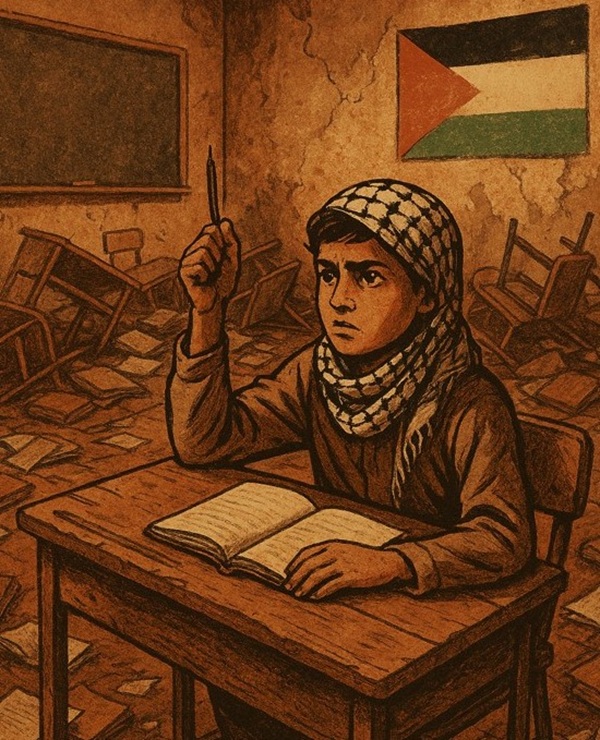
The next day, armored vehicles rolled into Birzeit University and Al Quds University. Guards were handcuffed, doors smashed, placards seized. Leaflets warned students that their organizations were “terrorist activity.” This was not about security — it was about silencing thought, criminalizing education, and sending a chilling message: Palestinian universities are now direct targets.
Birzeit officials rightly called it a “systematic colonial policy.” When classrooms are raided, when students are threatened for organizing, when professors are treated as criminals, the goal is clear: to erode the intellectual backbone of Palestinian society. Education is resistance, and resistance is what Israel seeks to crush.
The Narrative War Abroad
Even in the United States, the struggle plays out in subtler but no less insidious ways. At Wissahickon High School in Pennsylvania, a Muslim student club distributed keffiyehs and displayed images critical of Israel.
Jewish parents complained, framing cultural expression as political provocation. But let’s be honest: wearing a keffiyeh is no different than wearing a kippah. Criticizing a government’s policies is not antisemitism.
The outrage reveals a deeper bias: Palestinian identity itself is treated as suspect, as though any expression of solidarity must be policed. Meanwhile, billions in U.S. aid continue to bankroll the occupation, ensuring that Palestinian children grow up under drones, checkpoints, and rubble.
Voices That Refuse to Be Silenced
Pro-Palestinian voices cut through the noise. One commentator put it plainly: media narratives obsess over feelings of “intimidation” while ignoring the children of Gaza and the West Bank. Another reminded us that Palestinian students face intimidation everywhere, not because of what they do, but because of who they are — descendants of a people displaced for 77 years.
This is the heart of the matter: Palestinians have endured military rule, systemic discrimination, and collective punishment for generations. Their suffering is not an accident — it is policy, sustained by international complicity and U.S. funding. To call this anything less than brutal occupation is to deny reality.
Conclusion: Whose Flag, Whose Future?
From UN compounds to university campuses, from East Jerusalem to Pennsylvania classrooms, the battle is not just over land — it is over dignity, identity, and truth. Israel’s raids are not isolated incidents; they are part of a broader project to erase Palestinian presence, whether by tearing down flags, raiding classrooms, or stigmatizing cultural symbols abroad.
But every keffiyeh worn, every classroom rebuilt, every voice raised in solidarity is a reminder: Palestinians are not going anywhere. Their struggle is not just for survival — it is for liberation. And liberation begins with refusing to let the world look away.