In the United States, debates over immigration and election integrity have long shaped political discourse. But in recent years, these issues have become central to a broader struggle over the future of American democracy. Many analysts, civil rights advocates, and legal scholars argue that the rhetoric surrounding immigration “crises” and election “fraud” is increasingly being used as a tool to justify policies that restrict voting access and undermine public trust in democratic institutions.
President Donald Trump has played a defining role in this shift. Throughout his political career, he has repeatedly claimed — without evidence — that widespread voter fraud threatens U.S. elections. He has also framed immigration as a national emergency requiring extraordinary measures. Critics say these narratives are not isolated talking points but part of a coordinated strategy to consolidate political power by sowing distrust and narrowing the electorate.
A Push to Use Immigration Enforcement at the Ballot Box
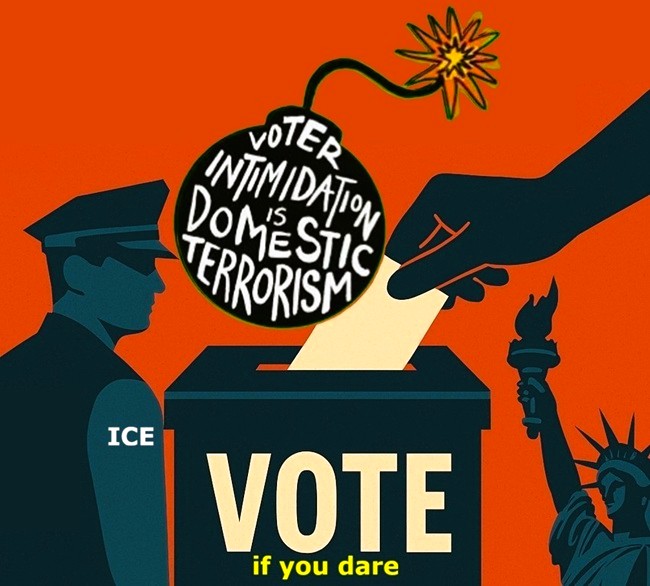
One of the most controversial proposals circulating among Trump-aligned activists is the idea of deploying immigration enforcement officers to polling places. Civil rights organizations warn that such a move would intimidate Latino, Asian American, and other minority voters, regardless of their citizenship status. Legal experts note that federal law already prohibits voter intimidation, and the presence of armed federal agents at polling sites would raise serious constitutional concerns.
Voting rights groups argue that these proposals echo historical tactics used to suppress turnout among marginalized communities. The mere threat of immigration enforcement, they say, could discourage eligible voters from participating — especially in states where elections are decided by narrow margins.
Mail Voting Under Attack Despite Widespread Use
Trump has also repeatedly criticized mail-in voting, calling it “corrupt” and claiming the United States is “the only country in the world” that uses such a system. Election researchers and state officials across the political spectrum have consistently refuted these claims. Several states — such as Colorado, Utah, Oregon, Washington, and Hawaii — conduct elections almost entirely by mail, with strong bipartisan support and no evidence of systemic fraud.
Ironically, Trump himself has frequently voted by mail. Millions of Americans, including military personnel stationed abroad, rely on absentee ballots every election cycle. Studies from institutions such as the Brennan Center for Justice and the MIT Election Data and Science Lab have found that voter fraud rates in the U.S. are exceedingly low, regardless of voting method.
Critics argue that the real danger lies not in mail voting but in efforts to delegitimize it. By repeatedly asserting that elections are “rigged” or “stolen,” they say, political leaders erode public confidence and create a pretext for restricting voting options.
Calls to Centralize Elections Raise Alarms
Another point of concern for democracy advocates is the suggestion that federal authorities should “nationalize” elections or even postpone them. The U.S. Constitution gives states primary authority over election administration, and experts emphasize that postponing federal elections would require an act of Congress — something that has never happened, even during wars or national crises.
Legal scholars warn that proposals to centralize election control in the executive branch would represent a dramatic departure from constitutional norms. They argue that such ideas reflect a broader pattern: using claims of chaos or corruption to justify expanding presidential power.
The Challenge of Responding to Disinformation
One of the most difficult questions facing journalists, policymakers, and voters is how to respond to persistent falsehoods about elections and immigration. Since 2015, Trump has frequently labeled mainstream news outlets as “fake news,” a phrase that has since become a rallying cry among his supporters. Media researchers note that this strategy — discrediting independent sources of information — has been used by political leaders around the world to consolidate power and weaken democratic checks and balances.
The spread of election-related misinformation has had measurable effects. Surveys from the Pew Research Center and other organizations show that trust in U.S. elections has sharply declined among certain segments of the population. Experts warn that once public confidence erodes, it becomes far easier for political actors to justify restrictive voting laws or challenge legitimate election outcomes.
A Slow Justice System and an Urgent Timeline
For those concerned about voter suppression, the legal system offers limited reassurance. Court challenges to restrictive voting laws can take years to resolve. By the time a case reaches the Supreme Court, multiple election cycles may have already passed under the contested rules.
This delay creates a sense of urgency among voting rights advocates, who argue that democracy cannot rely solely on litigation to protect itself. They emphasize the importance of civic engagement, local organizing, and public education to counter misinformation and defend democratic norms.
A Crossroads for American Democracy
The United States is approaching a pivotal moment. The debates over immigration, election security, and presidential power are not merely policy disagreements — they reflect competing visions of what American democracy should be. One vision emphasizes broad participation, institutional checks and balances, and trust in the electoral process. The other frames elections as inherently suspect and argues that extraordinary measures are needed to “restore order.”
As the nation moves toward another election cycle, the stakes are unmistakably high. The outcome will shape not only who holds political power but also the rules and norms that define American self-government. Whether democracy strengthens or weakens may depend on how effectively the public can distinguish fact from fiction — and how committed citizens remain to the principles of free and fair elections.