The quiet terror that never fully leaves those who’ve lived through collapse
There are moments when the past stops feeling like memory and starts feeling like a warning. For those of us who have lived through war, ethnic cleansing, or the collapse of civil order, fear doesn’t arrive as an abstract idea — it arrives as a familiar echo. It settles into the body the way winter settles into old wounds. It tells you to pay attention. It tells you that safety can vanish faster than people want to believe.
Today I received an email from my good friend “A”, a naturalized American who like to stay anonymous in this article. He’s someone who has lived through war, displacement, and the collapse of civil order — experiences that shaped him into a cautious, hyper‑vigilant prepper. When I opened his message and saw the image he had attached (the image at the top), I felt a knot form in my stomach. He’s someone who knows what it looks like when institutions turn predatory, when neighbors disappear, when the rules stop protecting the people they’re supposed to protect. His words hit me with a force I wasn’t prepared for, because they came from a place I recognize all too well.
Below is the message he sent — raw, frightened, and painfully honest. It’s not just his story. It’s the story of anyone who has already lived through the unthinkable once and now feels the tremors of something familiar.
“Hi Mel,
I’m writing because I’m overwhelmed with stress and fear, and my autism makes it hard to speak clearly on the phone. Yesterday I watched a video of ICE agents breaking into the home of an elderly U.S. citizen. They dragged him outside into freezing weather while he stood there in his underwear, confused, and helpless.
ICE agents knock at his door three times fast without giving him chance to answer, and then they smashed their way inside his house with battering rams. Watching that scene triggered my PTSD instantly. My brain flipped into survival mode. I went straight online and ordered heavy‑duty door barricades so I could reinforce both entrances. My mind kept racing: protective gear, gas mask, defensive positions — anything to buy time if something like that ever happened to me.
After that, I began placing my guns and ammunition throughout the home that I usually kept secure and hidden from the thieves if they break into the house when we are away. Mel, I refuse to be taken away without due process. I refuse to disappear into a system where 5 people have already died this year. Good thing that years ago I installed iron security bars on all our windows except one. Now that single unprotected bay window feels like a gaping wound in the house, but I will probably secure that one as well.
I told my wife that if anything happens, she should take our dog and shelter in the basement. She’s terrified too, but she doesn’t share my readiness to face death. I hope none of this becomes real, but my mind won’t let me ignore the possibility. Last night I barely slept, drifting in and out of short naps while fully dressed.
This morning, I found another video of the same elderly man. He appears to be of Asian descent and speaks with an accent. He said ICE released him only after his son arrived with proof of his citizenship. They offered no explanation to him for why he was taken.
You know me, Mel. I’m law‑abiding. I love this country. But I’m afraid they might come for me because of my outspoken criticism of Israel’s actions in Palestine. Our government is run by Zionist networks and right-wing extremists, and everything we say online is recorded and traceable.
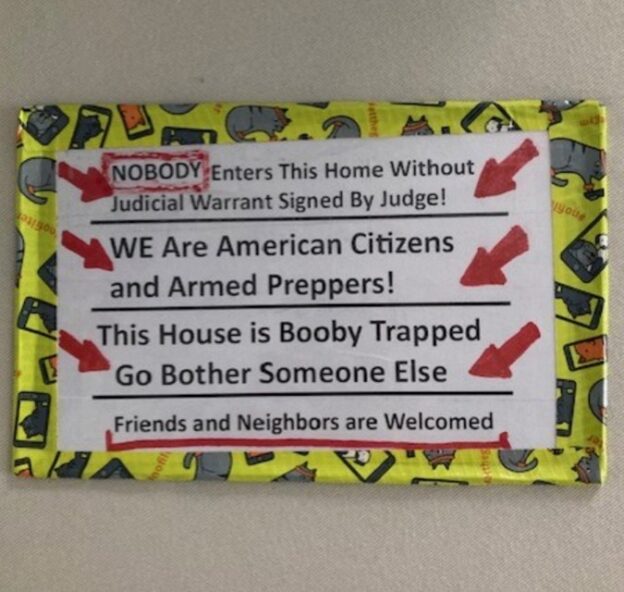
The image I attached is the warning sign I made and placed on my front door.
My neighbor offered to run errands for us. She’s devastated by what she’s seeing — crying when she watches these videos and witnessing how people are treated.
That’s all for today — day two of my self‑imposed lockdown. Call me when you can.
Stay safe,
A”
After reading his email, I called him. His voice shook. He tried to sound steady, but the disappointment in his fellow Americans — those who participate in or support what he sees as an authoritarian shift — weighed heavily on him. His fear is not abstract. It comes from lived experience, from memories of what happens when institutions stop protecting people and start targeting them.
A deeper truth behind the fear
There’s a part of this story that many Americans don’t understand — not because they’re uncaring, but because they’ve never lived through the kind of terror that brands itself into your nervous system. For people who have survived war, ethnic cleansing, or authoritarian regimes, the fear of being taken, silenced, or stripped of rights is not a metaphor. It’s not a political talking point. It’s a memory that lives under the skin.
People like A carry the knowledge of what happens when a government decides someone doesn’t belong. They had seen homes raided without warning. They had seen neighbors disappear. They had seen families torn apart with no explanation. They had seen justice collapse overnight.
When you’ve lived through that once, you never stop watching for the signs.
That’s why the A’s fear feels so real today. It’s not about wanting conflict. It’s about refusing to ever again be powerless, voiceless, or at the mercy of a system that doesn’t see your humanity. It’s about the promise he make to himself after surviving the unthinkable: never again.
This is the part I want readers to understand. The barricades, the vigilance, the sleepless nights — they’re not about aggression. They’re about survival instincts shaped by history. They’re about the determination to never again be taken from your home, denied due process, or left wondering if you’ll live to see another day.
For some of us, that fear is not hypothetical. It’s lived experience. And it shapes how we see the world today.