A series of whistleblower disclosures has pulled back the curtain on a controversial internal Immigration and Customs Enforcement (ICE) memo issued in May 2025 — one that authorizes agents to enter homes using administrative warrants rather than judicial warrants signed by a judge. For decades, the rule was simple: ICE could not enter a private residence without judicial approval. But according to the memo shared with Congress by two anonymous government officials, that long‑standing protection has quietly been rewritten.
What the Memo Actually Says
The memo, signed by Acting ICE Director Todd Lyons, claims that the Constitution and immigration law do not prohibit ICE from entering homes to arrest individuals with final removal orders, even when relying solely on Form I‑205 — an administrative warrant created and signed by DHS personnel, not a neutral judge.
Whistleblower Aid, the nonprofit representing the officials who leaked the memo, argues that this guidance violates both the Fourth Amendment and DHS’s own policies. Historically, administrative warrants were not considered sufficient to enter private homes because they lack judicial oversight. Yet instructors for new ICE recruits are reportedly being told that Form I‑205 now authorizes forced entry without consent.
Even more concerning, the memo was allegedly distributed verbally, shown briefly to select employees, and then taken back—creating what whistleblowers describe as an “accountability vacuum.”
DHS Defends the Policy
DHS officials insist that individuals served with administrative warrants have already received due process and final removal orders from immigration judges. They argue that administrative warrants have long been recognized as legitimate tools in immigration enforcement.
Vice President JD Vance echoed this defense, saying the memo simply reflects the use of “different types of warrants” within the immigration system and that administrative warrants are part of due process.
Critics Sound the Alarm
Legal experts, immigrant advocates, and at least one U.S. senator strongly disagree. Sen. Richard Blumenthal called the policy “terrifying,” warning that it effectively authorizes government agents to break into homes without judicial approval — something the Fourth Amendment was designed to prevent.
Immigration attorney Rosanna Berardi described the memo as a “fundamental Fourth Amendment challenge,” especially given the way it is being implemented: through verbal instructions that contradict written training materials.
The Minnesota Incident: A Real‑World Test Case
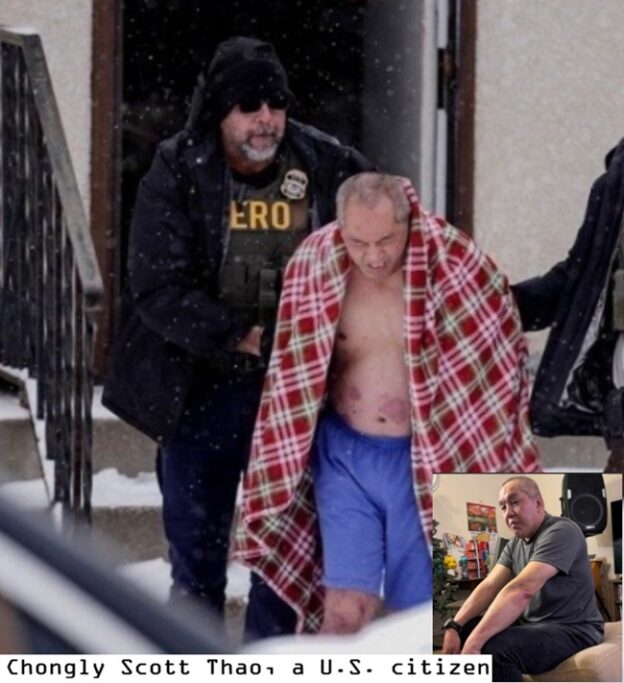
The debate over legality and procedure became more than theoretical when ICE agents forcibly entered a Minnesota home while searching for two undocumented individuals with criminal records. Instead, they detained Chongly Scott Thao, a U.S. citizen, who was taken from his home wearing only a blanket, boxers, and slippers.
Thao says agents did not ask for identification until after he was handcuffed. He was released the same day once relatives provided proof of citizenship.
This incident raises obvious questions about whether agents are following even the rules outlined in the memo — rules that require agents to knock, announce themselves, and confirm probable cause before entering.
My Perspective: When the Policy Meets Reality
Even if we accept DHS’s claim that administrative warrants are part of due process, the Minnesota case shows a stark disconnect between policy on paper and actions in the field.
- There was no valid administrative warrant for Thao, because he is a U.S. citizen and therefore not subject to a removal order. His same ‑ day release supports that.
- Agents knocked only three times and immediately forced entry, contradicting the memo’s requirement to knock, announce, and wait for admittance.
- Thao’s state of undress strongly suggests he was asleep, not refusing to answer the door. People do not sleep fully dressed by the front door waiting for ICE.
In other words, the Minnesota raid appears to violate the very procedures ICE claims to be following. And when Vice President Vance frames the memo as harmless “administrative process,” it rings hollow in the face of what actually happened. This defense feels less like legal reasoning and more like political spin — more Kool‑Aid for MAGA members.
The core issue isn’t just immigration enforcement — it’s the precedent being set. If administrative warrants can replace judicial warrants, and if agents can break into homes with minimal oversight, then the constitutional protections Americans rely on become dangerously fragile. The Minnesota case shows how easily the wrong door can be kicked in, the wrong person detained, and the wrong rights violated. And once that line is crossed, it becomes harder to draw it again.
In addition, DHS and ICE have tried to frame the raid on Chongly Scott Thao’s home as a simple mistake — the wrong address, an unfortunate mix‑up. But when you look at the broader context, that explanation starts to fall apart. The more likely issue is not a wrong house, but a lack of proper investigation, fueled by a system that increasingly relies on citizen tips rather than verified evidence.
Just a month earlier, DHS publicly encouraged Americans to report “illegal aliens” in their neighborhoods, even suggesting that doing so could help bring down housing costs. Their message on X said it plainly: “Want affordable housing? Help report illegal aliens in your area.” But this raises an obvious question: How exactly are ordinary neighbors supposed to know someone’s immigration status? There’s no database, no ID check, no legal way for a private citizen to confirm anything. So what ends up happening? People rely on superficial cues — accents, skin color, who looks “foreign,” who doesn’t fit their idea of what an American should sound like.
If ICE acted on a tip like that in Thao’s case, it would explain a lot. It would explain why they targeted a U.S. citizen. It would explain why they showed up with such certainty yet had no valid warrant tied to him. And it would explain why they forced their way in without giving him time to answer the door. When enforcement is driven by unverified neighborhood suspicion rather than real investigative work, mistakes aren’t accidents — they’re predictable outcomes.
DHS’s call for citizens to report their neighbors doesn’t just make no sense; it actively encourages racial profiling and sloppy enforcement. And when that culture meets a policy that allows forced entry without judicial oversight, the result is exactly what we saw with Thao: an American citizen dragged out of his home because someone didn’t like the way he looked or sounded.